
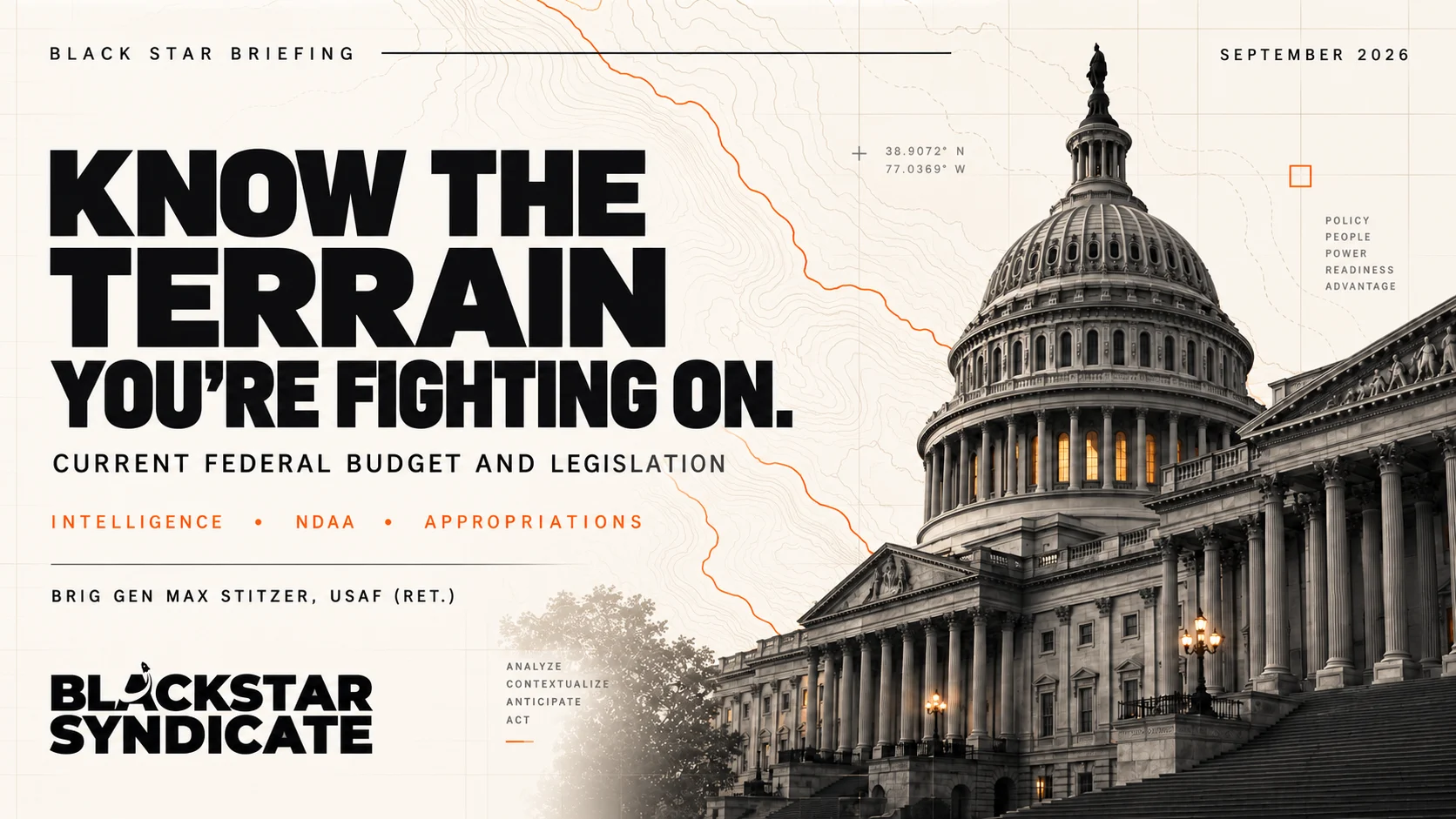
September 9, 2026
Brig. Gen. Max Stitzer, USAF (Ret.)
Advisor, Black Star Syndicate
Editorial Disclosure: This article reflects Black Star Syndicate’s independent assessment of current federal budget, defense, and legislative developments as of September 9, 2026. It is provided for general informational and strategic-planning purposes only and does not constitute legal, lobbying, procurement, investment, or other professional advice.
Legislative Intelligence
“Therefore, to estimate the enemy situation and to calculate distances and the degree of difficulty of the terrain so as to control victory are virtues of the superior general.” — Sun Tzu, The Art of War, Chapter 10, “Terrain.”
For industry, vendors, and suppliers to the Department of Defense (DoD) and the broader defense enterprise, federal authorization and appropriations are terrain that shapes strategy, timing, investment, and opportunity. The annual National Defense Authorization Act (NDAA), appropriations process, supplemental funding, and congressional procedure influence when programs can move, what authorities apply, and where pressure points emerge.
This is Black Star Syndicate’s assessment of an unusually unsettled FY 2027 legislative and budget cycle. The defining features are a short-term continuing resolution, an abbreviated House calendar, unresolved appropriations, an incomplete FY 2027 NDAA process, and the prospect that a limited number of late-year legislative vehicles may carry many competing priorities.
The CR Avoids a Shutdown, For Now
On September 2, 2026, President Trump signed H.R. 6500, the Continuing Appropriations and Extensions Act, 2027. The House approved the Senate-amended measure by a 370–48 vote on September 1, after the Senate approved the measure 90–6. The law provides short-term funding for covered federal operations through December 11, 2026, unless applicable FY 2027 appropriations legislation is enacted earlier.
The continuing resolution avoids an October 1 funding lapse at the beginning of FY 2027, but it does not complete the appropriations process. Congress must still enact regular appropriations measures, consolidate them into a larger package, or pass another continuing resolution before December 11 to avoid another funding deadline.
Congress has shifted its hardest choices from the October 1 funding deadline into a compressed period that will likely extend into the post-election lame-duck session, where appropriations, defense policy, supplemental funding, and other priorities may compete for the same limited legislative vehicles.
House: Narrow Margin, Short Calendar
House leadership shortened the pre-election legislative schedule after enactment of the continuing resolution. The House is scheduled to return September 14 and meet through September 17 before departing until after the November 3 election, absent an unforeseen recall or forcing event. Republican leaders canceled the final two scheduled weeks of September floor activity, leaving only four planned House legislative days before Election Day.
The week’s floor action demonstrated the fragility of the House GOP’s operating margin. Reps. Jared Golden (D-ME) and Marie Gluesenkamp Perez (D-WA) helped Republicans adopt a procedural rule by a 210–208 vote. Their votes were pivotal to the rule, not to passage of the continuing resolution itself, which moved separately under suspension of the rules and passed with broad bipartisan support.
The practical lesson is clear: with a narrow majority and recurring procedural disagreements, House leadership cannot assume that future appropriations rules or high-stakes legislative packages will move cleanly. That creates additional uncertainty for any effort to bring FY 2027 appropriations measures to the floor before the election.
House Majority Leader Steve Scalise (R-LA) and the broader House leadership team face the challenge of preserving floor capacity while managing divisions within the Republican Conference. The planned schedule leaves little room for complex bicameral negotiation before November.
Senate: More Calendar, Few Easy Answers
The Senate is scheduled to return September 14 and, under its tentative 2026 schedule, is expected to remain in Washington through October 2 before an October state work period. That provides more pre-election floor time than the House. But the House’s planned departure after September 17 constrains the likelihood that major bicameral legislation can be completed before Election Day.
The Senate Appropriations Committee, led by Chair Susan Collins (R-ME) and Vice Chair Patty Murray (D-WA), remains central to whether Congress can build bipartisan FY 2027 appropriations packages in the lame-duck session. The committee’s leadership has a record of working across party lines, but substantial policy and topline differences remain.
Senate Budget Committee Chair Ron Johnson (R-WI) may continue work on an FY 2027 budget resolution. However, committee activity should not be mistaken for an imminent floor vote. A budget resolution can establish a fiscal framework and, if drafted with reconciliation instructions, create a pathway for reconciliation legislation; it does not itself fund the government.
Bottom line: the Senate may have more days in session, but calendar time alone does not produce bipartisan consensus, resolve policy disputes, or guarantee floor action.
Appropriations: December 11 Is the Forcing Mechanism
House Appropriations Committee Chair Tom Cole (R-OK) and Ranking Member Rosa DeLauro (D-CT) have institutional incentives to complete FY 2027 appropriations rather than push the process into January and a new Congress. Regular order provides appropriators more influence over spending priorities and policy provisions than another broad continuing resolution.
The appropriations path remains uncertain. A post-election agreement could take the form of individual bills, a minibus, an omnibus, or another short-term patch. The outcome will depend on post-election political incentives, leadership priorities, unresolved policy riders, and the willingness of both parties to accept a negotiated package.
The December 11 expiration of the CR is therefore a forcing mechanism, not necessarily a finish line. Congress could still enact another short-term extension and defer final FY 2027 spending decisions into January. A lengthy legislative to-do list should not be mistaken for a prediction that Congress will complete every item.
For the defense industrial base, a prolonged CR can create familiar problems: delayed program starts, reduced flexibility for new initiatives, uncertainty around production planning, and a more difficult environment for companies relying on timely awards, contract modifications, or new starts. Continuing resolutions generally restrict new starts and production-rate increases unless Congress provides express statutory exceptions, commonly known as anomalies.
Defense Funding: Need, Vehicle, and Timing
Several potential paths could shape the defense-funding outlook:
- Regular FY 2027 appropriations.
- The FY 2027 NDAA.
- An emergency national-security supplemental.
- Targeted bridge funding for urgent requirements.
- Future reconciliation legislation, if Congress establishes a viable procedural and political path.
These options are not interchangeable. Appropriations provide budget authority. Authorization legislation establishes or modifies policy, programs, and ceilings. Reconciliation follows special budget procedures but depends on an adopted budget resolution with relevant instructions. Emergency supplementals require agreement on both substance and legislative vehicle.
Additional defense funding remains under active discussion, but the likely vehicle, total amount, and timing remain unsettled. Public reporting and congressional discussion have included emergency supplemental funding, targeted bridge funding, and potential reconciliation approaches. These mechanisms carry different vote thresholds, time requirements, policy constraints, and prospects for enactment.
Iran-related operations add urgency to the broader defense-funding debate. Reporting has described an administration request for an $87.6 billion emergency supplemental package, including approximately $67.1 billion in requested defense funding. Secretary Hegseth has separately described Iran-war costs at roughly $37.5 billion as of July 2026. These are estimates with different scopes; they should not be treated as a single, interchangeable defense-funding number.
If operational demands continue to rise and Congress does not identify a viable funding path, national-security requirements could become the event that forces additional House action. The core challenge is not simply whether additional defense resources may be needed; it is whether congressional consensus can form quickly enough around the amount, the vehicle, and the associated policy conditions.
NDAA: A Must-Pass Vehicle Under Pressure
The House passed H.R. 8800, its version of the FY 2027 National Defense Authorization Act, on July 22, 2026, by a 216–212 vote.
The Senate’s version, S. 4784, was reported from the Senate Armed Services Committee but has not passed the Senate. On July 14, the Senate failed 50–46 to invoke cloture on the motion to proceed to S. 4784. A motion to reconsider was entered, but no further procedural steps toward Senate floor consideration had occurred as of the latest Congressional Research Service update.
House Armed Services Committee Chair Mike Rogers (R-AL), Senate Armed Services Committee Chair Roger Wicker (R-MS), House Defense Appropriations leadership, and Senate Defense Appropriations leadership will be central to determining whether the FY 2027 NDAA reaches conference and final passage in the lame-duck period.
The House considered H.R. 8800 under H.Res. 1438, which the House agreed to on July 21 before completing consideration and passing the bill on July 22. The House-passed NDAA contains provisions that could complicate Senate consideration and eventual House-Senate negotiations. The final legislative outcome will depend on whether House and Senate leaders can resolve policy differences during the lame-duck period.
The NDAA may become one of the few must-pass measures with enough momentum to move late in the year. If that occurs, stakeholders across government and industry will seek to attach unresolved priorities: defense acquisition provisions, intelligence matters, technology policy, sanctions, export controls, industrial-base authorities, and other provisions that cannot otherwise secure floor time.
For industry, the right question is not merely whether the NDAA passes. It is whether the final package includes or excludes the authorities, funding direction, acquisition reforms, and policy provisions that shape the market in FY 2027 and beyond.
The Lame-Duck Scenario
The central challenge is familiar but particularly acute: a lame-duck session with more unresolved priorities than available legislative time.
Potential contenders for post-election attention include:
- FY 2027 appropriations.
- NDAA completion.
- Emergency or supplemental national-security funding.
- Possible reconciliation legislation.
- Expiring surveillance or intelligence authorities.
- Russia sanctions and other foreign-policy measures.
- Farm-bill issues.
- Disaster and agriculture assistance.
- Committee, leadership, and chairmanship decisions for the next Congress.
Congress will have only a limited number of legislative weeks between the election and Christmas, with the Thanksgiving recess further reducing available floor time. The NDAA and appropriations could become the principal must-pass vehicles, increasing competition over amendments and policy riders.
A Democratic House majority after the midterms could prefer to defer major spending decisions into January, when a new majority would hold greater leverage. Conversely, outgoing Republicans could have an incentive to enact policy priorities before any transfer of control. If Republicans retain the House, they will still face the same arithmetic problem: a narrow operating margin makes unified action difficult.
The election will not merely determine who holds power in January. It will reshape incentives for what Congress can accomplish during the final weeks of 2026.
Leadership and Committee Stakes
The committee gavels matter. For defense and aerospace industrialists, leadership of the House Armed Services Committee, House Appropriations Committee, Defense Appropriations Subcommittee, Senate Armed Services Committee, and Senate Appropriations Committee can be nearly as consequential as party control of the House.
Committee leadership influences priorities, hearing agendas, oversight intensity, programmatic focus, appropriations strategy, acquisition-policy direction, and the pathways through which industry concerns reach Congress.
The House leadership landscape also matters. Speaker Mike Johnson (R-LA), House Majority Leader Steve Scalise (R-LA), House Minority Leader Hakeem Jeffries (D-NY), House Democratic Whip Katherine Clark (D-MA), and House Democratic Caucus Chair Pete Aguilar (D-CA) will shape their respective parties’ negotiating posture during the end-of-year session.
Several chairmanship and waiver questions may emerge as members and party steering committees prepare for the next Congress. Those decisions should be monitored, but preliminary rumors should be treated carefully until confirmed by official announcements, committee communications, or credible on-the-record reporting.
Space: A Signal of U.S.-European Friction
The space domain is becoming increasingly contentious. Reporting indicates that the White House discouraged several U.S. space companies, including SpaceX, Stoke Space, K2 Space, and Astra, from attending French President Emmanuel Macron’s September 9–10 International Space Summit in Paris, citing concerns that attendance could be perceived as endorsement of European Union policy positions.
French authorities separately reported that SpaceX, Blue Origin, Stoke Space, and Starcloud canceled planned participation. The companies initially contacted and the companies publicly reported as withdrawing are not identical, an important distinction when describing the episode.
The summit is not merely a diplomatic event. It is an indicator of growing U.S.-European friction over commercial-space competition, technology policy, market access, regulatory approaches, and Europe’s push for greater strategic autonomy in space. France has framed the gathering around international cooperation while also emphasizing European space sovereignty and autonomous access to space.
For the U.S. space industrial base, the policy signal is worth watching: commercial competition, export controls, launch-market access, satellite communications, sovereign capability, and allied policy alignment are becoming increasingly interdependent.
Key Dates and Decision Points
- September 14–17: Both chambers return; the House has only four scheduled legislative days before departing for the election period.
- September 18–October 2: The Senate remains in session. Watch appropriations discussions, Budget Committee activity, NDAA procedure, and any movement on urgent defense-funding mechanisms.
- October–November 3: Campaign season dominates, barring an unforeseen national-security, funding, or procedural crisis.
- November 4–December 11: The primary lame-duck pressure period. FY 2027 appropriations, NDAA completion, defense funding, and other unresolved priorities will compete for a limited number of legislative days and must-pass vehicles.
- December 11: The current continuing resolution expires unless Congress enacts full-year appropriations or another extension.
Bottom Line
Congress has delayed its hardest FY 2027 choices. The continuing resolution has avoided a lapse in appropriations at the start of FY 2027, but it has also concentrated major decisions into a short post-election period. The next three months will determine whether Congress completes appropriations, advances the NDAA, provides additional defense resources, and resolves other high-priority matters, or again relies on a temporary extension and pushes core decisions into 2027.
For defense, aerospace, technology, and dual-use companies, this is not a time to watch from the sidelines. The legislative environment will reward organizations that understand the process, maintain a clear view of decision-makers and committees, anticipate potential funding vehicles, and engage early enough to influence provisions that move.
Black Star Syndicate will continue monitoring the federal budget, defense authorization, appropriations, national-security supplemental funding, and emerging technology-policy environment to help our ecosystem remain competitive, innovative, and productive.
“Plan for what is difficult while it is easy; do what is great while it is small.” — Lao Tzu, Tao Te Ching, Chapter 63.
Editorial Note: This article reflects Black Star Syndicate’s good-faith assessment of the federal budget and legislative environment as of September 9, 2026. Congressional schedules, bill text, funding levels, vote counts, committee actions, executive-branch requests, and political conditions can change quickly. This analysis is provided for general informational and strategic-planning purposes only. It is not legal advice, lobbying advice, procurement advice, investment advice, or a representation of official U.S. government policy. Readers should consult primary legislative and agency sources, as well as qualified counsel or government-relations professionals, before making decisions based on pending federal actions.

Max Stitzer
Brigadier General, USAF (Ret.) | Advisor, Black Star Syndicate