
Salt Lake City · August 2026
Paul Peters on Leadership and His Next Summit
Paul Peters has spent more than 30 years leading people through conditions most of us will never face. Combat zones. Minefields. Helicopters taking fire. High mountains where a wrong decision has permanent consequences. Along the way, he built a leadership philosophy that has almost nothing to do with technique and almost everything to do with who a person becomes.
That distinction matters to him more than most.
“Organizations don’t become high-performing,” Peters says. “High-performing organizations are simply the byproduct of high-performing people who trust one another, communicate clearly, make sound decisions, and execute with discipline.”
It sounds simple. It is not easy.
The Foundation Is the Person, Not the Position
Most leadership training starts with skills. Peters starts somewhere else entirely. He starts with the person.
“The first responsibility of a leader is to become the kind of person who can be trusted with responsibility,” he says. That means self-awareness. Character. Discipline. Humility. The willingness to keep learning long after anyone would expect you to already know the answers.
Peters spent more than 25 years inside U.S. Special Operations Forces. He served as the second-in-command of a 23,000-person organization as Deputy Commanding General of 1st Special Forces Command. He commanded the 19th Special Forces Group, ran U.S.-Iraq military engagement as head of the Military Advisory Group in Iraq, and visited more than 35 countries over the course of his career. None of that, he’ll tell you, is the point. It is the proving ground.
“Leadership starts within,” he says. “The first person you lead is yourself.”
An Eight-Stage Framework Built from Experience
Peters has organized his philosophy into a progression: Becoming, Leadership, Trust, Clarity, Decision, Execution, Growth, and Legacy. It starts with the individual and moves outward, toward the team, the organization, and eventually what a person leaves behind.
He is careful to say it is not a rigid checklist. Leaders cycle through it constantly. Adversity can knock you back to an earlier stage without warning. What the progression captures is a simple piece of logic: the quality of an organization is downstream from the quality of the people inside it, and the quality of those people starts with the quality of their character.
Trust sits at the center of the framework, and Peters is direct about what it takes. “You are either building trust or eroding trust,” he says. “There is no in-between.” He breaks it into pieces any team can act on: reliability, competence, accountability, character, transparency, respect, reciprocity, and showing up when things get hard, not just when they are easy.
Clarity comes next, and it is where Peters’ military background shows up most clearly. “Leadership is clearing away the storm, the chaos, and the complexity so that people can see what matters, what is right, and what is needed, and then leading them through it,” he says. When conditions are calm, he points out, leadership can look easy. Anyone can hold a course when the skies are clear. The real work starts when the storm rolls in and people lose sight of the plan, the mission, or each other.
Judgment Under Pressure
Peters rarely had perfect information in the field, and he tells people that is normal, not a failure state. Good decisions get made under uncertainty, with incomplete facts, on a timeline that will not wait for more data. His guidance is practical: get facts before acting on the first report, know the difference between what you control and what you do not, and do not go it alone when someone else has the expertise you lack.
Execution follows decision, and Peters is blunt about the difference between the two. “Managers execute the plan,” he says. “Leaders create the plan.” Process matters, but only as a means to an end. The moment process becomes the product, an organization has lost the plot.
Growth as the Real Objective
Peters pushes back on the idea that success is the goal. In his framework, success is a byproduct of daily effort, learning, and character built under real conditions. He asks the people he coaches a short list of questions on a regular basis: What did you learn today? What challenges did you overcome? How did you help someone else grow?
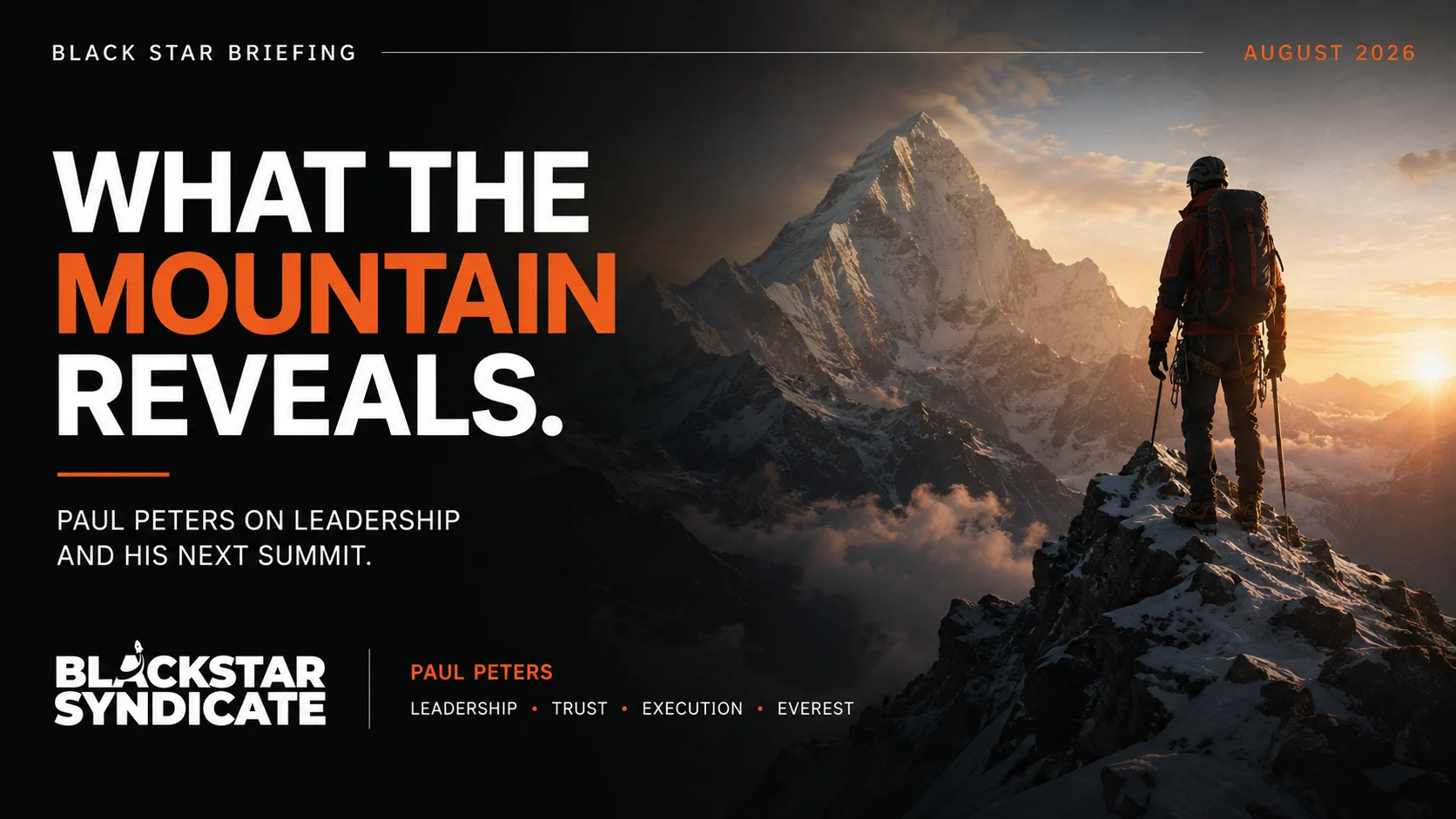
It is the same lens he brings to mountaineering, which has shaped his thinking as much as his military career. Peters has summited Mt. McKinley, Chimborazo, Cotopaxi, Kilimanjaro, Mount Rainier, and the Grand Teton. There’s an old mountaineering truth: the mountain doesn’t care who you are—but it will reveal exactly who you are. The same is true, he argues, of leadership under real pressure. Titles do not survive contact with hard conditions. Character does.
Next Up: Everest
Peters is now preparing for his next and biggest test yet: an attempt to summit Mount Everest. It is the natural next chapter for someone who has spent a career studying what pressure reveals about a person, and he is approaching it the same way he approaches everything else in his philosophy. Preparation before the moment of need. Judgment under uncertainty. Respect for a mountain that will not care about his resume.
For Peters, the climb is not separate from the leadership work. It is another proving ground, and another set of lessons he plans to bring back to the people he coaches and teaches.
Black Star Syndicate will be following Paul’s preparation and the climb itself in the months ahead, and we want our community along for it. If you would like to follow his progress, support the expedition, or connect with Paul directly, reach out to us at team@blackstarsyndicate.com or paul@blackstarsyndicate.com.
Why This Matters Now
Peters built this philosophy from lived experience, not a textbook. That is what makes it land differently with the executives, teams, and students he now works with. He is not teaching theory. He is translating decades of decisions made when the cost of getting it wrong was measured in something more than a quarterly report.
His core belief carries over from the battlefield to the boardroom without needing to be reworded: people come first, trust is built one action at a time, and leadership is not a title anyone gets to keep. It is something you have to keep earning.
Black Star Syndicate is proud to work alongside Paul Peters as he continues to build this philosophy into a framework that leaders at every level can use, and as he takes on Everest, we invite you to be part of the journey.

Paul Peters
Featured by Black Star Syndicate