By Elijah Taylor
More than sixty years ago, Salt Lake City psychologist Cal Taylor conducted NASA-supported research on the people behind scientific progress. This week, SmallSat marks forty years of collaboration in the same city. The question remains: how do we recognize real potential before it becomes obvious?
How do we recognize real potential before it becomes obvious?
It is not a question that usually appears in the language of technological progress. We tend to tell that story through hardware: the rocket flies once the physics is solved, the satellite shrinks once the components allow it, and the system scales once the economics finally work.All of that is true.
It is also incomplete.
Before the physics is solved, someone has to stay with a problem the field considers premature. Before the system scales, someone has to pursue a possibility without enough evidence to make everyone else comfortable. And before an industry becomes infrastructure, someone has to see the work clearly enough to keep doing it through the years when it is still easy to dismiss.
This week, thousands of engineers, researchers, founders, operators, investors, and public-sector leaders have gathered in Salt Lake City for the 40th Annual Small Satellite Conference. The conference has grown over four decades around a field that once occupied a narrower place in the space conversation and now sits within the global infrastructure of communication, observation, navigation, and security.
The conference has made me think about my grandfather.
Not because he predicted the small-satellite industry. He did not. Not because he designed spacecraft or understood orbital mechanics in the way the people gathered here do.
He spent his life asking a different version of the same question.
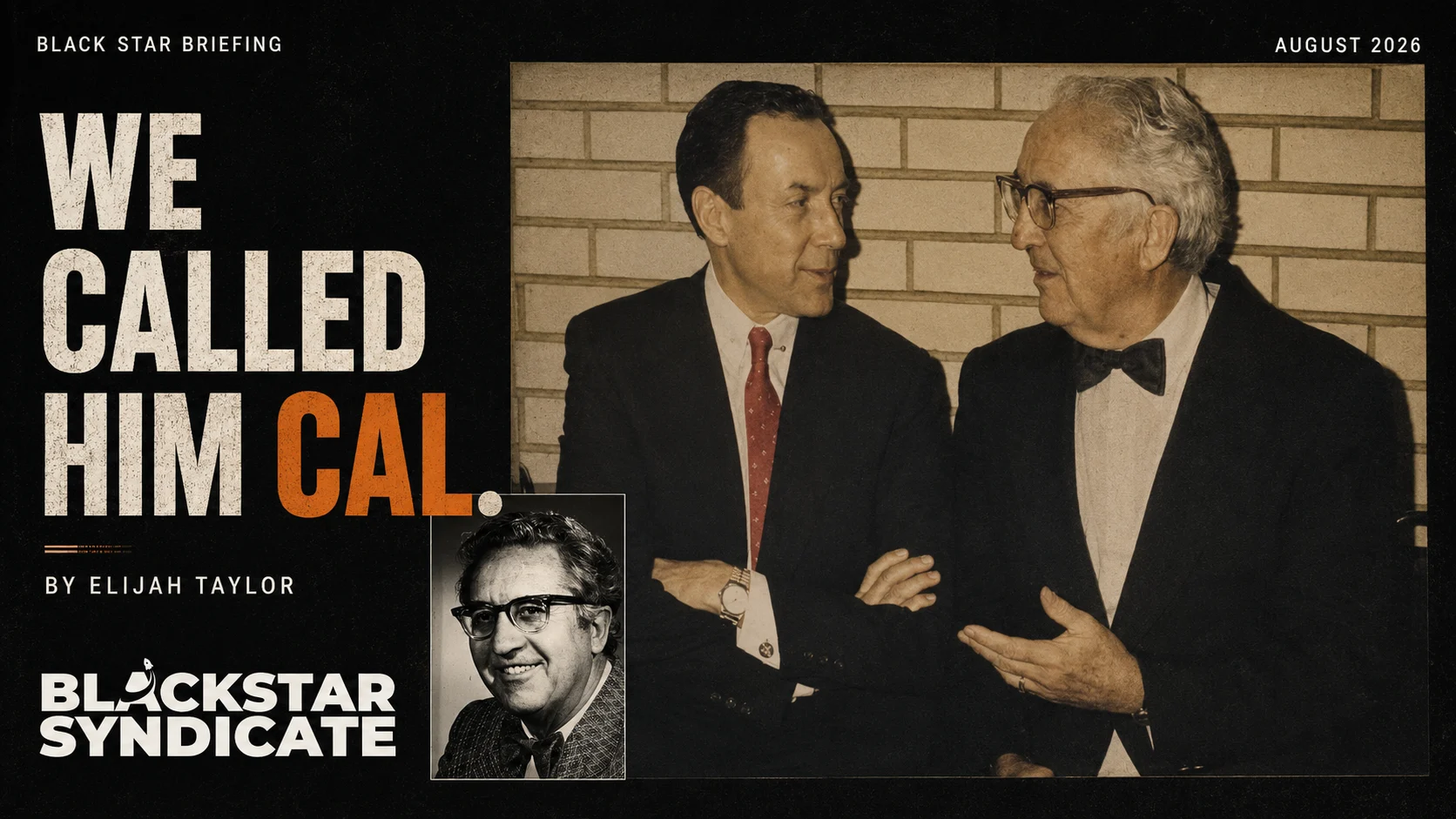
We called him Cal.
His professional name was Dr. Calvin W. Taylor: a University of Utah psychologist, creativity researcher, educator, Army officer, and one of the early figures in the scientific study of human potential. But in our family, he was Cal.
I have memories of him, though they come back as fragments rather than a complete picture. What I remember most clearly is not a lecture, a publication, or even a story about the career that made him significant to other people.
It is watching him care for my grandmother, Dorothy, through some of her harder years.
He was patient. He was kind. He was present in the quiet, unremarkable way you only learn to recognize once you are old enough to understand how much work that kind of presence requires.
Whatever else he understood about talent, he did not seem interested in performing intelligence. He gave his attention to the person in front of him. I suspect he would have considered that the more important accomplishment.
He was also, by every account I have heard, a respected figure well beyond his own field, a peer of Senator Orrin Hatch. He later encouraged his daughter, my aunt Nancy, to take a position in Hatch’s Washington office, a job that turned into a forty-plus-year career in DC. Decades after that, I became one of Hatch’s own last interns, back in Salt Lake City, without fully realizing at the time that I was stepping into something Cal had started.
Cal’s professional life was devoted to an argument that now feels obvious only because people like him spent decades making it harder to ignore: intelligence is not one thing, and neither is talent.
He earned his doctorate at the University of Chicago under L. L. Thurstone, whose work challenged the idea of a single, unitary intelligence. Taylor carried that premise into a career that moved from Army personnel research during and after the Second World War to more than five decades of teaching, research, and institution-building at the University of Utah. He ultimately retired from the Army Reserve as a lieutenant colonel.
The question followed him.
How do we recognize what someone is capable of before they have had the chance to prove it in conventional ways?
At the University of Utah, Cal convened a series of conferences on creative scientific talent, bringing leading researchers into a serious conversation about creativity, cognition, education, and the environments that allow original work to emerge. He later founded the Institute for Behavioral Research in Creativity, known as IBRIC, in Salt Lake City, creating an institutional home for work on talent identification, educational evaluation, organizational development, and measurement.
His Multiple Talent framework argued that traditional academic measures capture only a narrow slice of what people can contribute. Alongside academic ability, he identified capacities such as productive thinking, decision-making, planning, forecasting, communication, implementation, human relations, and discerning opportunities.
It was not an argument against standards.
It was an argument against mistaking one standard for the whole person.The work that brings him closest to the subject of this week was NASA-supported research he conducted with Robert L. Ellison. Their research examined biographical information from more than 2,000 scientists and asked whether the patterns of a person’s life, interests, experiences, beliefs, self-descriptions, and orientation toward work, could help predict scientific performance and creativity.
The result was not a formula for genius. It was a challenge to institutional complacency.
Professional self-confidence, independence, and autonomy emerged as important predictors of creative scientific performance. In plain language, the people most likely to contribute original work did not always arrive with the signals institutions found easiest to measure. They often had the capacity to hold a conviction under disagreement, to work without constant affirmation, and to remain with a difficult problem longer than others were willing to stay.
That remains an uncomfortable idea.
Institutions prefer signals that are legible. They prefer credentials that can be compared, résumés that can be sorted, and explanations that make talent feel predictable. There are good reasons for that. Systems need standards.
But standards become dangerous when they harden into blindness.
Some people capable of meaningful work are still early. Some are working alone. Some do not yet have the title, degree, affiliation, capital, or social proof that makes their potential easy to recognize. They may have an unusual question, a stubborn commitment to a problem, or a willingness to keep thinking when affirmation is absent.
The task is not to romanticize every outsider or treat unconventionality as proof of ability.
The task is to build institutions capable of recognizing genuine potential before it becomes obvious.
That is the part of Cal’s work I return to now.
I do not inherit his achievements. I do not get to claim the force of his research because we share a name. What I inherit is a question, and perhaps an obligation: to pay closer attention to the people and ideas that deserve a serious chance before they have accumulated all the proof the world prefers.
That informs the work we do at Black Star Syndicate.
We do not build satellites, and I am not the person to explain their orbital mechanics. But we work with founders, executives, and institutions attempting difficult things in complex environments. Our role is often to help create the relationships, strategic clarity, and institutional trust that allow a worthwhile idea to reach the people who can help carry it forward.
Most consequential work does not fail because it was necessarily wrong.
Sometimes it fails because it never reached the room where someone could recognize it.
It is also part of why, separately from Black Star, I have spent the last several months building something of my own: a modern, personal interpretation of the question Cal spent his career pursuing. It is meant to help individuals identify and name their own talents with more clarity, the way his research once asked institutions to see more clearly in the people before them. It is not public yet. When it is ready, I will share more.
SmallSat’s 40th anniversary is evidence of what can happen when an idea is given room, rigor, and durable collaboration. What began as a more limited category of space activity has become an essential part of the global technology and security ecosystem.
The conference will end. The badges will come down. The engineers, founders, researchers, operators, and public servants will return to work that remains unfinished.
My grandfather would have understood that part.
He spent a lifetime trying to make one fact harder to ignore: the people capable of changing what comes next do not always look like the people institutions expect. They may be quiet. They may be early. They may be doing the patient work of proving something before anyone else can fully see it.
This week, in the city where Cal built much of his life’s work, thousands of people have gathered around a future that once looked peripheral.
I suspect that would have pleased him.