
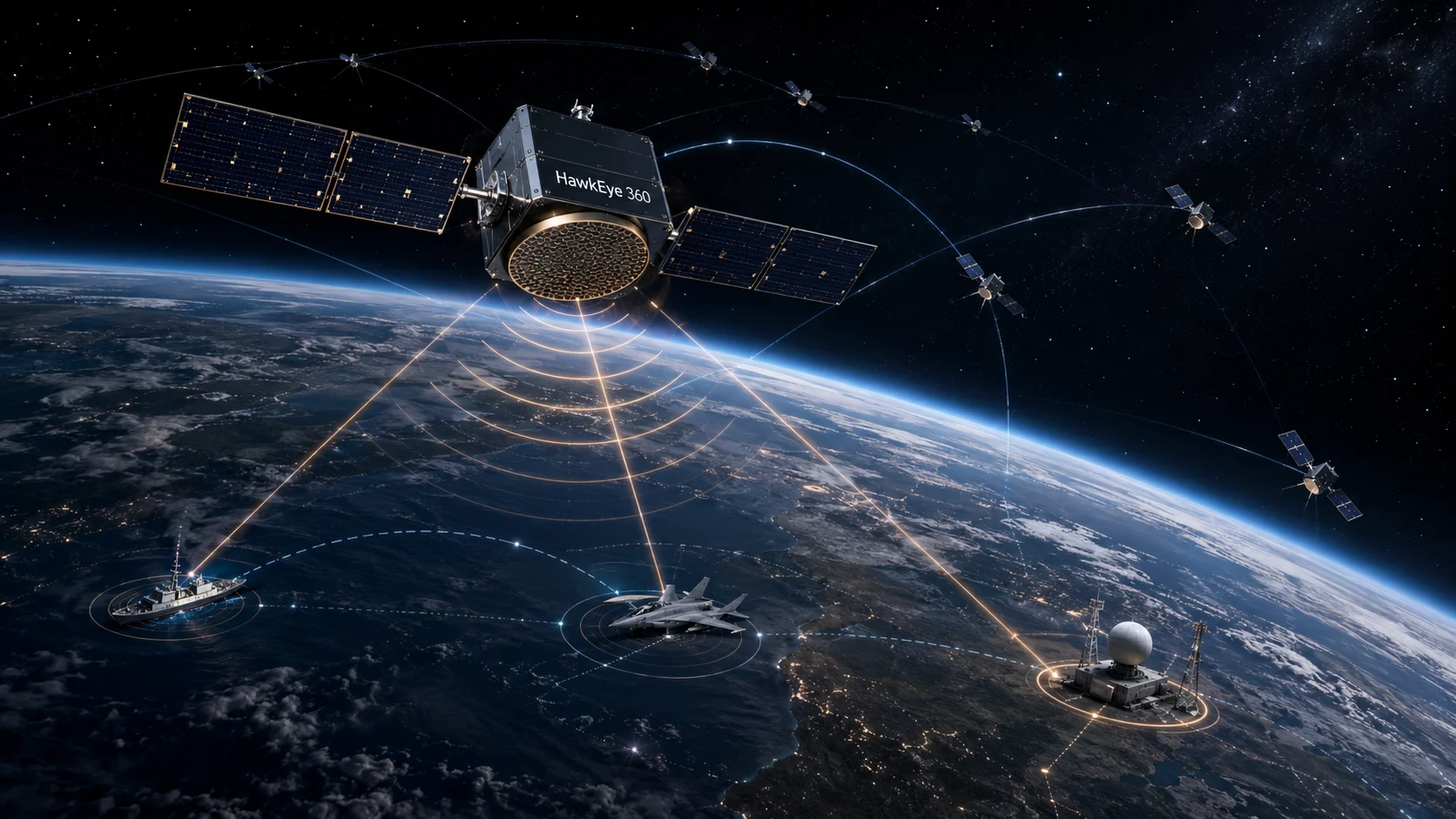
RF detection from space is quickly becoming one of the most important shifts in the defense industry.
From my view, the analytical takeaway is simple. If a platform emits, it creates a signature. That signal may come from a radar, radio, data link, jammer, ship, aircraft, drone, ground vehicle, or command node. Once that signal is detected from orbit, it can potentially be classified, geolocated, patterned, and fused with other intelligence sources.
Every signal becomes data. Every pattern becomes intelligence. Every careless emission can become a vulnerability.
This is no longer theory. HawkEye 360 already operates more than 30 satellites in low Earth orbit at roughly 500 kilometers altitude, using three-satellite clusters to detect and geolocate RF emissions. The National Reconnaissance Office has awarded and extended commercial RF sensing contracts, showing that the intelligence community sees real value in commercial space-based RF data. At the same time, the U.S. Space Force is investing billions into space-based sensing and data transport, including a $4.16 billion award for space-based airborne moving target indication and a $2.29 billion contract for a military space data-network backbone.
The market numbers point in the same direction. Space-based RF mapping is estimated in the low single-digit billions today, with projections reaching roughly $5 billion to nearly $10 billion by the early-to-mid 2030s. That spread shows the market is still forming, but the trend is clear. Defense customers want more persistent sensing, faster data flow, and better visibility into the electromagnetic spectrum.
Opportunity and Risk for Industry
For industry, this creates both opportunity and risk. It is no longer enough to build systems that move faster, shoot farther, or communicate over longer distances. We also have to ask what they emit, how often they emit, how predictable those emissions are, and whether those signatures expose the operator.
This matters across communications, electronic warfare, drones, counter-UAS, maritime awareness, targeting, missile warning, and command-and-control. Every signal becomes data. Every pattern becomes intelligence. Every careless emission can become a vulnerability.
The winners in the next defense cycle will be the companies that understand RF signatures, emission control, low probability of intercept communications, electronic deception, and multi-sensor fusion. Space-based RF detection is not making the battlefield perfectly visible, but it is making the spectrum far more observable.
The future fight will not only be about who has the best weapon. It will be about who can detect first, decide faster, control their signature, and operate while being hunted from above.
Onward,

Jon Williams
Black Star Syndicate